
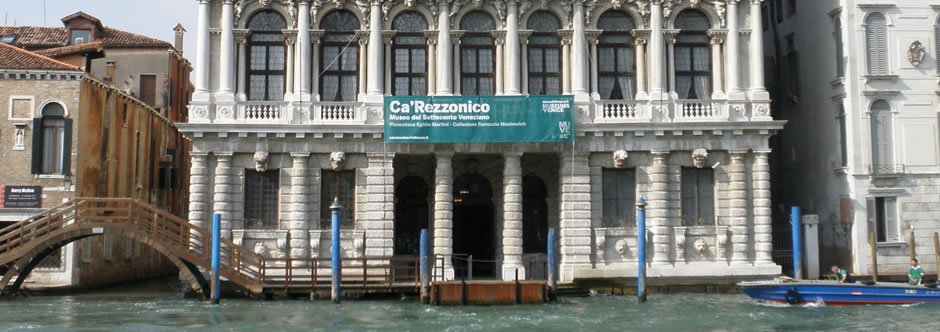
The Ca'Rezzonico Palace houses the Museum of 18th Century Venice. Baldassarre Longhena was employed by the Bon family to construct baroque-style residence and following the architect's death Massari completed the project for new owners – the Rezzonico family in 1756. This occurred at a time when Venice was a City-State. The three storey building faces the Grand Canal, it has stunning architectural features including the ceiling trompel'oeil frescos in the state rooms painted by a number of artists like Giambattista Tiepolo. There is a beautiful high ceilinged ball room created by Massari, with murals by Lombard Pietro Visconti and Crosato. The staircase has statues by Giusto le Court; there is a chapel with more frescoes and the palace has an interior courtyard. A hall connects the water entrance to the land entrance.
Apart from the magnificent architecture the palace holds treasures from 18th century Venice. Due to the sheer quantity of 18th century art in Venice it was necessary to "furnish" the palace with art which could not fit into the Correr Museum. There are additional Tiepolo frescoes, in addition to those in situ. The Throne Room holds artifacts which belonged to the Barbarigo family including a gilt chair sculptured by Antonio Corradini, which gives the room its name. The entire contents, including frescoes, have been rescued from decaying Venetian palaces and brought here, some entire rooms have been recreated to duplicate the original surroundings. You can see antique furniture, Venetian glass created by Murano, a Chinois-style salon from the Calbo-Crotta Palazzo and paintings by some of the city's greatest artists of the 18th century. On the side of the canal there is a staircase leading to a café overlooking the water and the Browning Mezzanine where you can see the Mestrovich Collection with works by Jacopo Tintoretto and Bonifacio de'Pitati. On the third floor you can see what an 18th century apothecary would have looked like with the Ai Do San Marchi Pharmacy exhibition.